What Should You Check Before Acting on an Identity Finding?
Before you act on an AI visibility finding about identity, check whose business the evidence actually describes. "AI confused your client with another company" can mean three different problems, and each one has a different fix. Pick the wrong one and your team fixes something that was never broken.
This guide gives agencies four checks to run in order, before an identity finding reaches a client. We tested the order on a real case: an audit of our own that measured the wrong company.
Why Does the Order of the Checks Matter?
The order matters because each check depends on the one before it. If the audit resolved the wrong company, every finding that depends on that identity is unreliable until the platform corrects it and reruns the audit. If the answers describe a different business, correcting their facts does nothing for your client.
The identity check, in order
Run the checks in order for each finding. Act on the first one that fails; when the evidence is unclear, go to check 4.
Right business audited?
No: the platform measured someone else. Rerun first.
Right business in the answers?
No: a same-named entity. Identity work.
Wrong fact or wrong business?
Right business, one detail wrong: correct the fact.
Enough evidence?
No: say so, verify, then decide.
These are diagnostic stages, not boxes that a whole report fits into. One report can contain more than one problem. The point is the sequence: whose business, then what is wrong with it.
“An analytical error produces a bad report. A generated recommendation built on an unverified entity produces a worse website.”
Radar engineering postmortem, July 2026
Prefer to watch? In under three minutes, Scout runs the four checks on a fictional pair of same-named businesses, Bramblecove Travel and Bramblecove Tours, the same example check 3 uses below.
Read the transcript
Same name. Wrong business? Hold that stamp. Before this report reaches your client, whose business did it actually measure? Let's open the folder. Our fictional client is Bramblecove Travel: custom itineraries in Lisbon. Bramblecove Tours runs coach day trips from Porto. Different websites. Different cities. Different trips. The names are only the starting point. First, check the business the audit identified. Do its domain, location and offering match what your client confirms? If the audit picked Tours when your client is Travel, stop there. Ask the platform to correct the business identity and rerun the audit. This report measured someone else. Set it aside before recommending a fix to your client. Once the audit targets the right business, inspect the actual AI answers. Here's an answer about coach trips from Porto, with the Tours website. But the question was about Travel in Lisbon. That is evidence of a different business. The next job is to make your client's identity clearer across their website and profiles. Now look at this answer. The website matches. Lisbon matches. Custom itineraries match. But the founding year is wrong. So, wrong business? No. This answer identifies your client and gets a detail wrong. Keep the original answer as evidence. Mark the fact for correction and give it to whoever owns the source. Adding this note doesn't change what AI says. That still needs checking. And what if the answer just says, “Bramblecove offers great trips”? No website. No clear location. No clue which trips. Or it lists both businesses and says it can't tell which you mean? That's uncertainty. There isn't enough evidence to call it a mix-up. Confirm the details with your client, then repeat comparable questions. Keep the questions, answers, providers and dates so you can inspect what changed. One report can contain several problems. Each finding needs its own check. Check who the audit measured, who the answers describe, what fact is wrong, and whether the evidence is clear enough to decide. Now you can explain what needs attention and who should act. The stamp can wait. I'm Scout, your guide to Radar.
Check 1: Did the Report Audit Your Client's Business?
The first check is whether the audit resolved the right company at all. A report can query the right engines and calculate every metric correctly while measuring a business that is not your client.
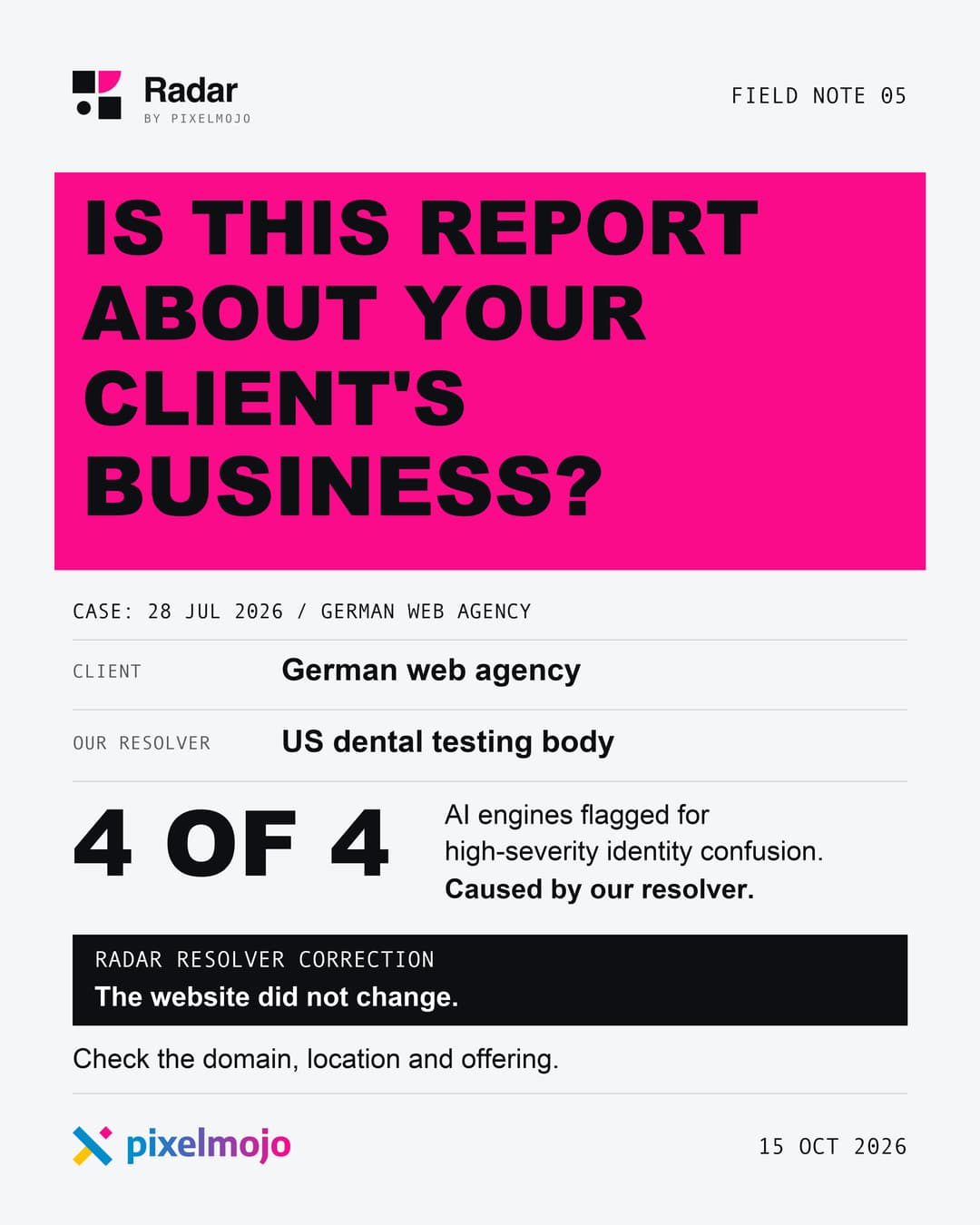
That happened to us. In July 2026 our resolver identified wreb.de as Western Regional Examining Board, a US dental testing body. The site belongs to WREB.DEsign GmbH, a web agency in Bielefeld, Germany, and said so in its own structured data. Three engines then named the dental board and the fourth named a Washington real estate board. The report read like a severe identity problem for the client. The problem was ours.

“I would definitely recommend Radar to another business. It gives useful insights, but just as importantly, there is clearly someone behind it who takes the results and customer feedback seriously and is willing to improve the product when something does not make sense.”
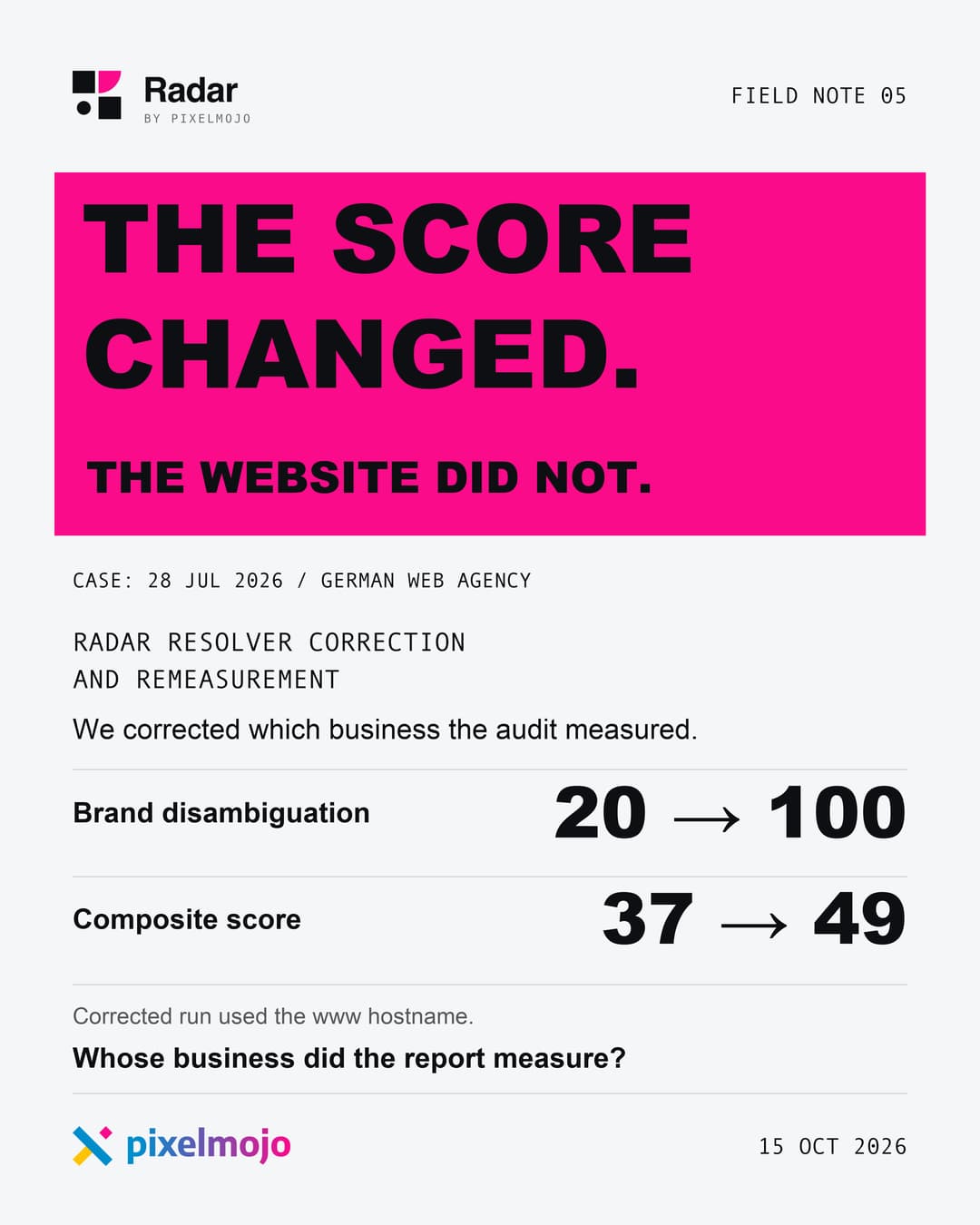
The wrong-company audit, before and after our resolver correction
Radar resolver correction and remeasurement for wreb.de, 28 July 2026. Not a website improvement: nothing on the site changed. The corrected run was requested at www.wreb.de.
Brand disambiguation score
Composite score
Website-only checks that scored the same in both runs
To run this check, compare the domain, location and offering in the report with what your client confirms, and ask the platform where it got the company name. If they do not match, rerun before anything reaches the client. We wrote up the full case, and six questions to ask any platform, in what a wrong-company audit taught us.
Check 2: Are the AI Answers About Your Client's Business?
The second check is whether the AI answers describe your client or a different business with the same name. This is a real finding about the market, not a tool error: the platform asked about the right company, and the engines answered about someone else.
The tell is a different domain, location or offering in the answer than the one your client confirms, stated as fact rather than offered as a possibility. An answer that lists two same-named businesses and says it cannot tell which one you mean is uncertain, not confused.
When the answers do describe another business, the next action is identity work on your client's side: a clear entity home, Organization schema and consistent profiles. Our brand disambiguation guide covers how engines resolve a name and how to fix a collision.
Check 3: Is It a Wrong Fact or a Wrong Business?
A wrong fact is not a wrong business. When an answer clearly describes your client's business, with the right domain, location and offering, but gets one detail wrong, that is a factual error about the right company. It needs a fact correction, not identity work.
The WREB audit shows the difference. Once our resolver named the right company, the engines were no longer describing a dental board. They still got things wrong: nine factual errors across three engines, including two invented founding years and a false claim about pricing. Those were problems with the facts, and they needed different owners from the identity problem.
Wrong business or wrong fact?
Illustrative example. Both businesses and both domains are fictional.
- Answer describes coach day trips from Porto
- Domain in the answer: bramblecove-tours.example
- Your client plans custom itineraries in Lisbon
- Next action: identity work
- Answer describes custom itineraries in Lisbon
- Domain in the answer: bramblecove-travel.example
- Says founded in 2015; the client confirms 2019
- Next action: correct the fact at its source
A wrong detail on its own does not prove a different business. It does not prove the right one either. Without a clear match on domain, location and offering, move to check 4.
What If the Evidence Is Not Clear Enough?
When the answers are too vague to tell which business they describe, the honest finding is that there is not enough evidence yet. Say so. A generic description, a hedge or a list of possible matches is not a basis for a fix.
Confirm the business facts with the client first. Then repeat comparable questions and record the date, the providers, the prompts and the responses, so the next check can be compared with this one. The same discipline sits behind our AI visibility evidence standard.
How Do You Take an Identity Finding to a Client?
Take the check that failed, not the headline. Each outcome has its own next action and its own owner, and the client conversation is easier when you can name both.
| What you see | Which check | Next action | Who usually acts |
|---|---|---|---|
| The report's company, domain or location is not your client's | 1. Right business audited | Rerun the audit before recommending anything | The platform, with your confirmation |
| Answers describe a same-named business as your client | 2. Right business in the answers | Identity work: entity home, Organization schema, consistent profiles | The client's content and web team |
| Answers describe your client but get a detail wrong | 3. Wrong fact | Correct the fact where it is published | Whoever owns that content |
| Answers are vague, hedged or list several matches | 4. Not enough evidence | Confirm the facts, rerun comparable questions, record them | Your team |
Keep the client version short. "This report measured a different company, so we are rerunning it." "AI answers are describing another business with your name, so the fix is identity work." "The answers know who you are and get one fact wrong, so we will correct where that fact comes from." "We do not have enough evidence yet, and here is what we will check next."
How Does Radar Help?
Radar is built to stop the first problem and to separate the others. Since July 2026 it resolves the company from the site's own first-party evidence, and a low-confidence identity stops for confirmation instead of flowing into a paid audit or generated fixes.
As of October 2026, its Brand Disambiguation check, in the Radar dashboard for paid users, asks ChatGPT, Claude, Gemini and Perplexity who the business is and flags same-named entity confusion by severity. Its Hallucination Check looks at identity first, and skips fact-checking an answer when it finds supported evidence that the answer describes a different entity. On that path, an isolated factual discrepancy, such as a wrong founding year or location, is not enough to count as entity confusion.
Check whose business the evidence describes
AI Report Identity Checks: Questions Agencies Ask
Common questions about this topic, answered.
How do I know an AI visibility report is about the right business?
Check what the audit resolved before you read any score. The domain, location and offering in the report should match what your client confirms about their own business, and the platform should be able to say where it got the company name. If they do not match, ask the platform to confirm which business it measured, and keep the report away from the client until it does.
What is the difference between a wrong business and a wrong fact in AI answers?
A wrong business is an answer that describes a different, same-named entity as your client. A wrong fact is an answer that clearly describes your client but gets one detail wrong, such as the founder or the founding year. They need different fixes: identity work for the first, a fact correction for the second.
Can an AI visibility tool audit the wrong company?
Yes, and ours did. In July 2026 our resolver identified wreb.de as Western Regional Examining Board, a US dental testing body, instead of WREB.DEsign GmbH, a German web agency. All four engines were then flagged for high-severity identity confusion that started with our tool. After we corrected the resolver and remeasured, the brand disambiguation score went from 20 to 100. That was a Radar resolver correction and remeasurement, not a website improvement: nothing on the site changed, and the corrected run was requested at www.wreb.de.
Does a wrong founder or founding year mean AI confused the business?
Not by itself. A wrong detail about a business the answer otherwise identifies correctly is a factual error, not a different business. After we corrected the WREB audit, three engines still made nine factual errors about the right company, including two invented founding years. Those needed fact corrections, not identity work.
What should an agency check before taking an identity finding to a client meeting?
Four things, in order. Did the audit resolve your client's business? Are the AI answers about your client's business? Is the problem a wrong fact or a wrong business? And is there enough evidence to say? Compare the domain, location and offering in the evidence with what the client confirms.
Who fixes an identity problem in an AI visibility report?
It depends on which check failed. A wrong company in the audit itself is the platform's problem, so rerun it before recommending anything. Answers that describe a different same-named business call for identity work on the client's site and profiles. A wrong fact goes to whoever owns the content that states it. When the evidence is unclear, verify before assigning anyone.
What if the AI answers are too vague to tell?
Treat it as not enough evidence, and say so. Do not recommend a fix yet. Confirm the business facts with the client, then repeat comparable questions and record the date, the providers, the prompts and the responses, so the next check can be compared with this one.
How does Radar help with identity checks?
Since July 2026, Radar resolves the company from the site's own first-party evidence, and a low-confidence identity stops for confirmation instead of flowing into a paid audit or generated fixes. As of October 2026, its Brand Disambiguation check flags same-named entity confusion by severity. Its Hallucination Check looks at identity first and skips fact-checking an answer when it finds supported evidence that the answer describes a different entity.
Settle Whose Business It Is First
An identity finding is only useful once you know whose business it describes. Check the audit, then the answers, then the facts, and say so when the evidence is not there yet. Your client gets a fix aimed at the real problem, and your team stops spending time on the wrong one.