What Is Changing at Pixelmojo in 2027?
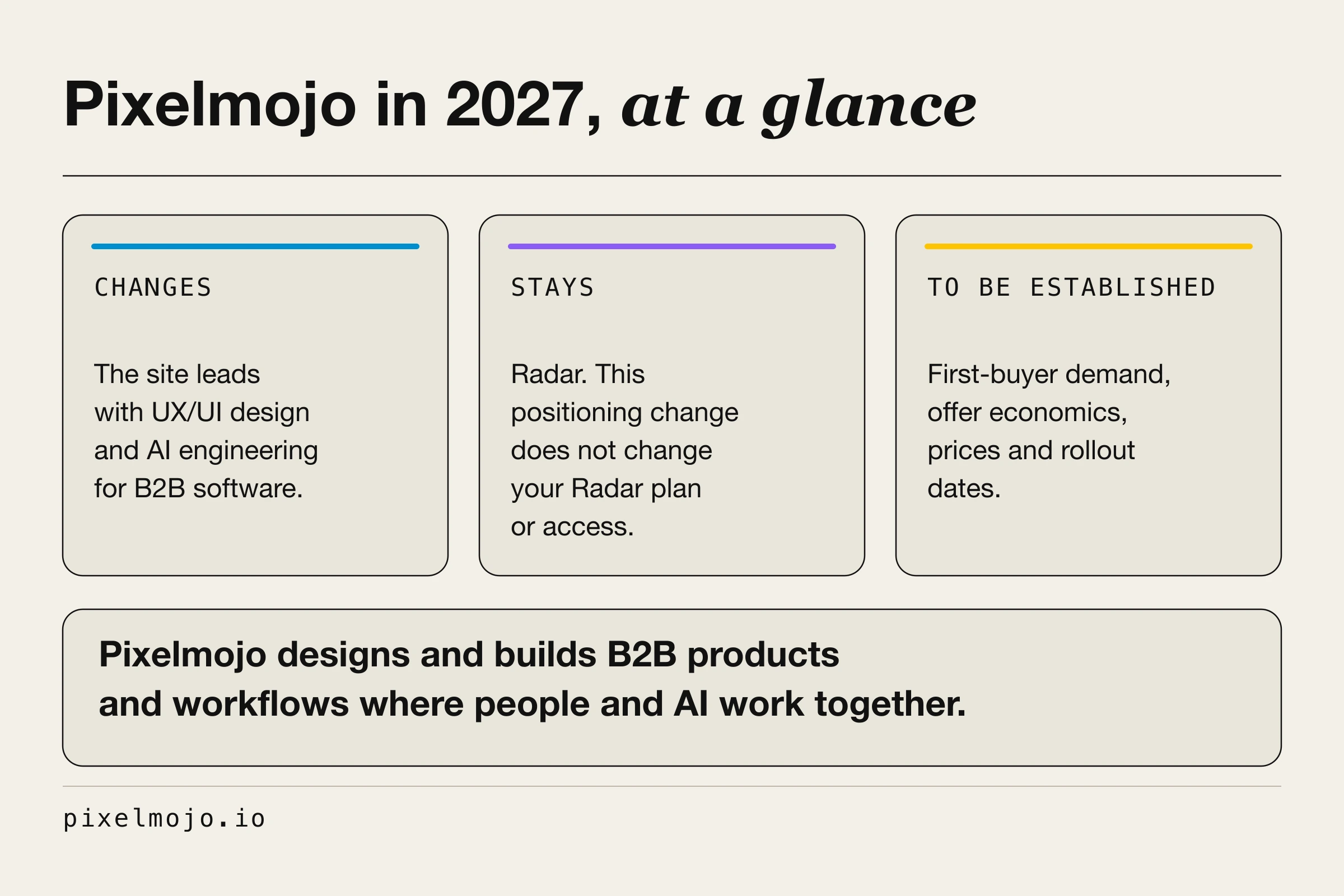
In 2027 Pixelmojo will lead with what it designs and builds: B2B products and workflows where people and AI work together. Our site's messaging will be overhauled to say that plainly. Radar, our AI visibility platform, stays. This positioning change does not change your Radar plan or access.
Today the site opens with AI visibility. As of 13 November 2026 the homepage headline reads "Be found when buyers ask AI." That describes Radar well. It does not describe the rest of what we do: UX/UI design, web products, full-stack engineering and agentic AI systems. A product leader who arrives with a usability problem, or with an AI feature that is not working, has to dig to find out that we can help.
We are writing this before the site changes, so nobody who uses Radar or reads our work is surprised by it. This post covers what will change, why, what stays the same, how we work, and what happens next.

| Today (November 2026) | From 2027 | |
|---|---|---|
| What the site leads with | AI visibility and Radar | UX/UI design and AI engineering for B2B software |
| Who it speaks to first | Businesses that want to be found in AI answers | B2B product leaders and founders adding or improving AI in a product |
| Radar | The lead product | Our own product, and the clearest example of how we build |
| Our method | A blog series on AX design | The named framework behind the work |
| First step with us | A free Radar snapshot | A conversation about your product. Radar is never a required first purchase. |
The direction is settled: the company statement, UX/UI design at the core and Radar continuing. Who buys first is not. Product teams are the first buyers we will test with, not buyers we have already won, and the last section says how.
Why Is Pixelmojo Changing Its Message?
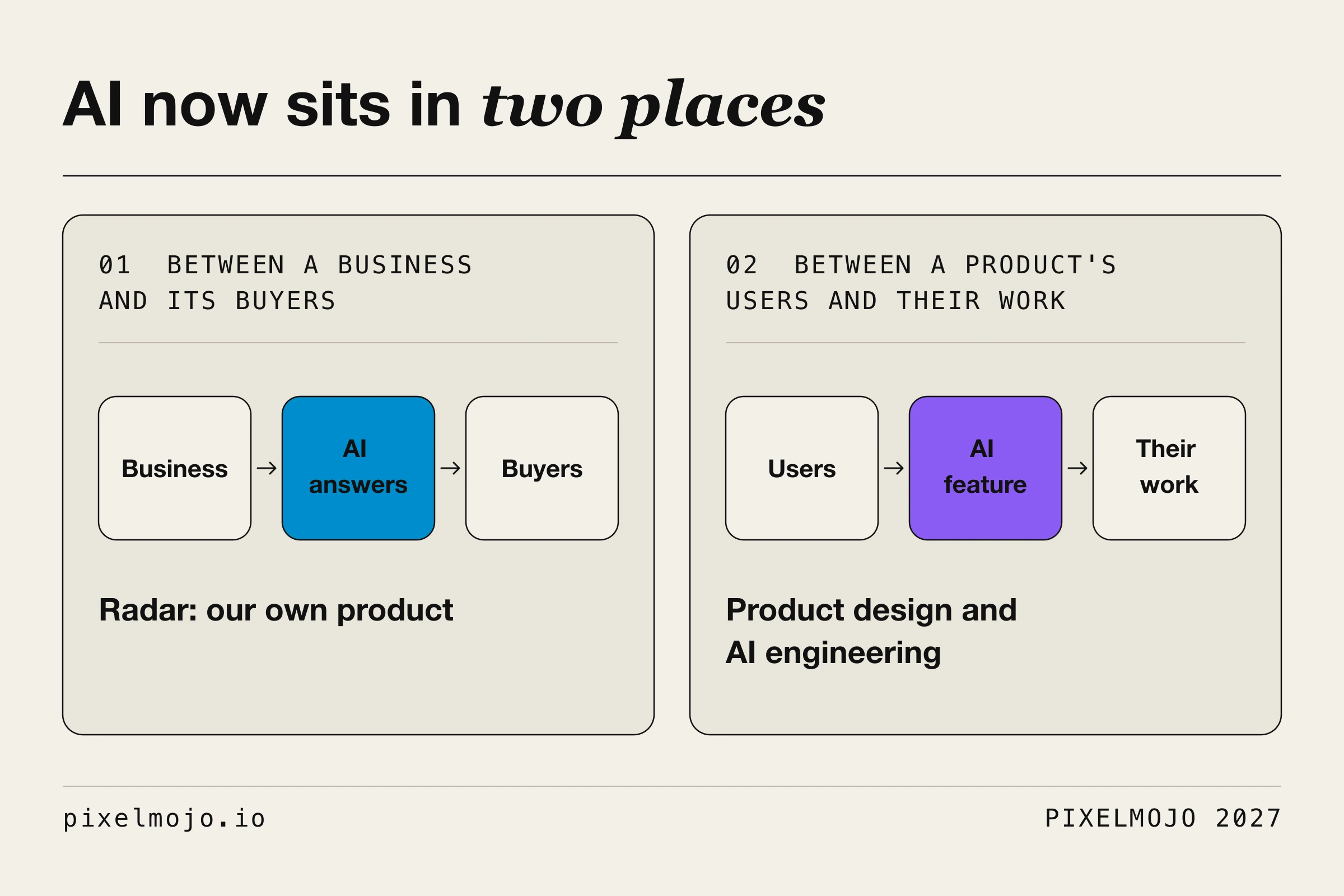
Because AI now sits in two places, and our site mostly talks about one. AI sits between a business and its buyers, who ask ChatGPT or Gemini before they visit a website. It also sits between a product's users and their work, inside the software they use every day. Radar addresses the first. Our design and engineering work addresses the second.
The second place is where a lot of AI work stalls. On 25 March 2025, CIO reported IDC research with Lenovo: 88% of the AI proofs of concept it observed did not reach wide-scale deployment. For every 33 a company launched, four reached production. The article does not give the sample or scope, and the figures count projects that did not reach deployment. They do not say why. Read them as a direction, not a benchmark.
Our view is that the work that decides it is the workflow around the feature: what people see and do, how the system acts, when it asks for input and how it hands work back. A demo proves a capability. A product needs that workflow. It is design and engineering work, and it is what we do.
A 2025 study points the same way. LLMs Get Lost In Multi-Turn Conversation, by Laban and colleagues, tested 15 models over more than 200,000 simulated conversations. It compared a task that arrives as one complete instruction with the same task unfolding over a conversation. Performance fell by an average of 39% across six generation tasks, which the authors attribute to "a minor loss in aptitude and a significant increase in unreliability". The conversations were simulated, not taken from a product in use, so the number does not transfer as it stands. It does suggest a risk worth testing in your own product: a feature that works in a clean test can behave differently in turn-by-turn use.
The other reason is closer to home. Between 16 August and 13 November 2026, Google searches showed our AX Design guide 8,828 times and recorded 121 clicks. That guide is about designing products where AI acts for people. It ends with a link to one service page and a contact form. Those figures show people finding the guide. They do not show demand for studio work. Separately, we want the next step for a product team to be clearer than a general service link, and that is ours to fix.

What Will Pixelmojo Do for B2B Product Teams?
Pixelmojo designs and builds B2B products and workflows where people and AI work together. UX/UI design is the core of that work, with AI engineering where the task needs it, done by one team. In one line: we help B2B software teams design, build and improve the product workflows around their AI capabilities.
“Pixelmojo designs and builds B2B products and workflows where people and AI work together.”
Pixelmojo company statement, carried into 2027

The work is for B2B product leaders and founders who are adding or improving AI in an existing product, with a defined user task and engineering support. Three situations describe when it applies.
The capability exists. The workflow does not. A model can do the task in a notebook or an internal tool. Nobody has decided where it starts in the product, what the user controls or what a finished result looks like.
The prototype works. Real use breaks it. The demo ran on clean inputs in front of a patient audience. Real users bring half-finished requests, messy data and cases nobody listed.
The feature shipped. Users still do too much of the work. People explain themselves to it, check its output line by line, correct it and then finish the job by hand.
There are three ways to start, depending on where the uncertainty is.
| Your situation | How we start | What you receive |
|---|---|---|
| The problem or scope is unclear | Product Workflow Review: one existing journey or one defined feature | A task map, prioritized experience problems, a recommendation on where AI, conventional automation and ordinary UX fit, action boundaries and exception handling, evaluation criteria and an implementation scope |
| One capability is uncertain | A bounded feasibility pilot on one workflow | Representative users and data, agreed evaluation criteria and a production decision |
| The brief is clear | A direct design-and-build scope | The agreed product experience and working implementation, with acceptance criteria and handoff defined before commitment |
Product research, interaction design, interface design and redesigns are also available on their own, with no AI build attached. There is no fixed ladder. A review is optional, and Radar is never a required first purchase. Prices are not set, so none are published here.
How Does Pixelmojo Work? The Rule Behind the Studio
We work to one rule: what the interface promises must match what the application enforces. It is why design and engineering sit in one team here.
“What the interface promises must match what the application enforces.”
Pixelmojo working rule for AI features
If the screen says a person will review something before it is sent, there must be no path in the code that sends without review. If a score appears, something must have earned it. If the product is not sure, it should settle that before a consequential action. A low-stakes draft can continue with the uncertainty visible.

One promise, two ways to build it
Our framing. The same AI feature, designed and engineered apart or together.
- The screen says a person reviews before anything is sent
- The code has a path that sends without review
- A confidence badge that nobody has checked
- A failure state with no next step
- Every promise on the screen has a rule in the application
- A score appears only when something earned it
- Uncertainty is settled before a consequential action
- Each failure has a designed next step
In practice the rule pairs every design decision with the implementation that goes with it.
| Design decision | Corresponding implementation |
|---|---|
| What the person needs to understand | Relevant evidence, progress and limitations |
| What the system may do | Enforced action and permission boundaries |
| When a person needs to intervene | Review, correction and handoff behavior |
| What counts as a useful result | Completion criteria, quality and total human effort |
Control should match consequence. A routine, low-stakes step should not ask for approval every time. A step that spends money, sends something outside the company or changes a record should have a boundary the application enforces. Keeping people in control means the right authority at the right moment. It does not mean a confirm button on everything.
We also start simple. Anthropic's guidance on building effective agents recommends "finding the simplest solution possible, and only increasing complexity when needed". Some steps need a model. Some need plain automation. Some need a better form. Microsoft's guidelines for human-AI interaction, presented at CHI 2019, set out what a product owes its user, including "Make clear what the system can do" and "Support efficient correction". Our reading is that neither can be met by design alone. Each needs the application to know its own limits and act on them.
This is what we mean by designing the experience and the behavior together. Our Agentic Experience Design framework connects the user's task, the interface and the system behind it. We define what AI should handle, what people need to understand and how the work continues when the system cannot finish. Other teams use the same term, and some mean something different by it; our AX Design guide covers the two meanings. Nothing here depends on the label.
What Does That Rule Look Like in Radar, a Product We Built?
In Radar, each screen in one task has a rule the product enforces behind it, and we learned those rules from an audit that measured the wrong company. Radar is the AI visibility platform we designed, built and run. It shows a business what ChatGPT, Claude, Gemini and Perplexity say about it. The task here is one a Radar user has: find out what AI gets wrong about the business, and decide what to change.
In July 2026 one customer's audit measured the wrong company. The old logic asked a model which company operated the domain and never read the site. The audit completed and returned an overall score of 37 out of 100, a believable D, about another organization. Worse, it generated a fix that told the customer to publish the wrong name on the company's own homepage. We published the full account, with the customer's permission, and rebuilt the flow. Here is what it does now.
One Radar task, four enforced rules
What the person does at each step, and the rule the product enforces behind it
Confirm the company
Below high confidence: no brand tools and no charge until confirmed
Inspect the evidence
A brand score the check cannot judge is withheld
Decide what to change
Generated fixes use only a verified or confirmed name
Check the result
A mention is never counted as a citation
Step 1. Confirm who is being audited
What the person sees. Radar reads the site to work out which company it belongs to: structured data first, then the site name, then the page title. When it is not highly confident, it stops and says so. The panel is titled "Confirm the company before running". It shows the name Radar resolved and the evidence it used, and it says why it is asking: the site gives conflicting signals, or the name is a guess from the domain. One button reads "Yes, that's the company". The person can also correct the name.
What the product enforces. Below high confidence, Radar requires that confirmation or correction before it runs the brand-dependent tools or charges a credit. Once the person answers, that answer is authoritative. It is tied to that site and carries into later runs. No automatic step may overwrite it.
Step 2. Inspect the evidence
What the person sees. The answers Radar collected from the AI engines, so they can check whether those answers describe the right business.
What the product enforces. When the brand check cannot judge an answer, Radar withholds that score. A withheld score is less satisfying than a grade. It is also more honest.
Step 3. Decide what to change
What the person sees. Suggested fixes for the site, such as schema markup and implementation prompts for the site's developers.
What the product enforces. A generated fix uses a company name only when the site's own data supports it with high confidence, or the person has confirmed it. Otherwise the fix carries a placeholder and a warning. This is the rule that matters most. A wrong score wastes time. A wrong fix, pasted into a live site, does damage.
“An analytical error produces a bad report. A generated recommendation built on an unverified entity produces a worse website. Those are different severity classes, and they deserve different safeguards.”
Radar engineering postmortem, July 2026
Step 4. Check the result
What the person sees. After changing the site, they run the audit again and compare the answers. Radar marks what changed between runs: a new mention, a lost mention, a new linked citation, a lost one.
What the product enforces. A mention is never counted as a citation. An answer that names a brand and an answer that links to its site are different facts, and the comparison keeps them apart.
What changed, and what we do not claim
On the corrected audit, the overall score moved from 37 to 49. That is still a D. Correcting the company did not make the report flattering. It made the report about the right business, with findings the customer could act on. The change in score reflects a corrected report, not better AI visibility.
Three limits matter. First, we do not claim a wrong company is now impossible. A site's own data can be stale or describe a parent company. The claim is narrower: a company Radar is unsure of cannot pass silently into a paid audit or into a generated fix without high-confidence evidence from the site or the person's confirmation. Second, changing a site does not guarantee that an AI answer changes. Radar shows what the engines say on the next run. Third, Radar is our own product. It shows how we make these decisions. It is not a client result.
The same pattern in a different product
The pattern is not about AI visibility. This example is hypothetical. Take a CRM assistant that turns meeting notes into a deal update. The notes name two companies. The assistant can draft the update, but it has to establish which account to change before it saves anything. The interface shows the account it picked and the evidence for the pick, and the person corrects it if it is wrong. That correction stays attached to the task. The draft separates details the notes support from details that are missing. After saving, the product shows which fields changed and gives a way to correct them. Three moves carry over: settle the identity an action depends on, keep the person's correction, and show what changed.
What Are We Revising in Our Own AX Playbook?
We are revising three things in our AX Design Playbook: recovery, confidence and autonomy. A change of message should come with a check of what we have already said, and building Radar showed where the playbook was too simple. We also add two lessons it did not cover. Each of the three passages now carries a dated note that points here.
- Recovery. In the guide we wrote: "Users must be able to reverse any agent action." It is not always possible. A sent email cannot be unsent. A payment can be refunded and a page unpublished, but what happened in between cannot be erased. Recovery depends on the action: some can be reversed, some can be corrected, some need a person. In Radar the strongest protection is not an undo. It is the gate that asks for confirmation before the brand-dependent tools run or a credit is charged.
- Confidence. In the trust patterns post we wrote: "When the agent is 95% confident, users need less oversight than when it is 60% confident." Only if the number has been checked against outcomes. A percentage nobody validated is decoration. In Radar, high confidence in a company name is not the model's opinion of itself. It comes from named evidence on the site, and the person can see that evidence.
- Autonomy. We described progressive autonomy as a pattern where "the level of agent independence increases over time as trust builds." The pattern is useful. We would now add that more autonomy is not the goal. The right human role depends on the task and on what happens when it goes wrong. Radar keeps one decision human for good: once a person confirms which company a site belongs to, no automatic step overrides it.
Two lessons are new.
- Engineering checks are not proof. Tests, evaluations and reviews are necessary. They do not prove the product behaves well for a person. The wrong-company audit completed and went undetected, because no run recorded where its subject came from. Every run now stores that record.
- Say what kind of claim it is. Research findings, published patterns, prototypes and behavior running in production are different kinds of evidence, and a reader should know which one they are looking at. In this post the Radar steps are shipped behavior, checked against the code. The review method below is our own. The research is cited where we use it.
What Stays the Same for Radar Users?
Your Radar plan and your access. Radar remains our own product and a core part of Pixelmojo. This positioning change does not change your Radar plan or access. You do not need to do anything. Radar itself will keep developing as a product, as it always has. That is separate from this change of message.

- Radar keeps its own pages and its own way in. You will still reach it the way you do today.
- The team is the same. The people who design and build Radar do the product work described here. Radar is where the rules in this post were learned.
- Vector and Hive remain custom builds. The client owns the application code, and we maintain the intelligence platform behind it.
- What you will notice. Over 2027 the homepage and service pages will talk less about AI visibility alone and more about the products we design and build.
If you came to Pixelmojo for Radar, Radar continues as our own product.
What Happens Next, and When?
The site's messaging will change during 2027, in steps. The first step, a page for product teams, is tested with buyers before it goes live. Later steps build on what those conversations and real engagements show. This is a direction with a plan, not a finished relaunch.

The planned order
No dates are fixed yet. Each step follows the one before it.
Buyer conversations
Product buyers read the draft page and tell us what they would hire us for
Studio page
A page under Services for product teams
Homepage and articles
A band on the homepage and links from our AX articles
Site messaging
The wider site follows during 2027
Some of this is settled and some is not, and we would rather say which.
- Settled. The company statement, UX/UI design at the core of the work, Radar continuing, and the order of the steps above.
- Agreed. The page for product teams will open with "Make AI useful in your B2B product."
- Still to be established. Who buys first, what the engagements cost to deliver, their prices, and the dates.
If those conversations show we have the audience or the offer wrong, the plan changes before the site does.
How Can You Review One Workflow in Your Own Product Today?
You do not need to wait for our site to change to use the method. Review one real attempt at a user task, then agree one change and how to check it. Bring the product lead, a designer and an engineer to the same walkthrough. Compare the AI-assisted path with the manual or previous way of doing the same task on the same inputs. Record whether the result meets the quality bar, and the total effort spent doing, checking and correcting the work. Then use six questions to choose the change.
Six questions for one workflow
Our review method. Ask them in order about one real attempt at one task.
Goal
What is the person trying to finish?
Steps
Who does each step today?
Model
Does each system step need one?
Boundaries
What may the system do alone, and where is that enforced?
Failures
What happens when it fails?
Done
What counts as done?
- What is the person trying to finish? Write the task as their goal, not as your feature. "Close the month's books", not "use the reconciliation assistant".
- Who does each step today? Map the task from start to finish. Mark each step as done by a person, by the system or by both. This is the task map.
- Does each system step need a model? For every step the system takes, choose the simplest thing that works: ordinary interface design, plain automation or AI. A step that was handed to a model may only need a better default or a rule.
- What may the system do alone, and where is that enforced? List every action it can take. For each one, name the boundary and find it in the code. If the boundary exists only in the interface copy, it is a promise the product does not keep.
- What happens when it fails? List the ways each AI step goes wrong: a wrong answer, no answer, a partial answer, an unsure answer. For each, name what the person sees and what they do next.
- What counts as done? Agree the completion criteria, the quality bar and the total human effort you will accept, including checking and correcting.
Three patterns are worth looking for.
- The promise without the rule. The copy says one thing and nothing in the application enforces it.
- The number without the evidence. A score or a confidence value that nobody has checked against outcomes.
- The dead end. A failure state with no next step for the person.
Leave with three things written down: one change, a named owner and a condition you can observe, such as a correction that still holds on the next attempt. Our post on AX metrics goes further on measuring the result.
Where This Leaves You
In 2027 Pixelmojo will say plainly what it does: design and build B2B products and workflows where people and AI work together. Radar stays, as our own product and as the place we learned how to do it.
If you use Radar, carry on. If you lead a product team with an AI feature that needs to earn its place, tell us where users get stuck in your product.
Tell us where users get stuck in your product
Pixelmojo in 2027: Questions About the Change
Common questions about this topic, answered.
What is changing at Pixelmojo in 2027?
In 2027 Pixelmojo will lead with what it designs and builds: B2B products and workflows where people and AI work together. The site messaging will be overhauled to say that. Radar, the AI visibility platform, stays.
Is Radar being discontinued?
No. Radar remains Pixelmojo's own product and a core part of the company. This positioning change does not change your Radar plan or access.
Do Radar users need to do anything?
No. This positioning change does not change your Radar plan or access. Radar keeps its own pages and its own way in.
Why is Pixelmojo changing its message?
AI now sits in two places: between a business and its buyers, and between a product's users and their work. Radar addresses the first. Pixelmojo's design and engineering work addresses the second, and until now the site has mostly described the first.
What will Pixelmojo offer B2B product teams?
UX/UI design and AI engineering for B2B software: research, interaction and interface design, and the engineering that turns an AI feature into a complete workflow. There are three ways to start: a Product Workflow Review of one journey or feature, a bounded feasibility pilot on one workflow, or a direct design-and-build scope. A review is optional.
Do I need a Radar audit before working with Pixelmojo on a product?
No. Radar is a product in its own right and an example of how Pixelmojo builds. It is never a required first purchase for product work.
When will the Pixelmojo website change?
During 2027, in steps. A page for product teams comes first and is tested with buyers before it goes live. A homepage band and links from the AX articles follow, then the wider site messaging. No dates are fixed yet.
What is the rule behind how Pixelmojo works?
What the interface promises must match what the application enforces. If the screen says a person will review something before it is sent, no path in the code may send without review.
What changed in Radar after it audited the wrong company?
In July 2026 one audit measured the wrong company and still returned a believable report. Pixelmojo rebuilt the flow around four enforced rules: below high confidence, require confirmation before the brand-dependent tools run or a credit is charged; withhold a brand score the check cannot judge; keep unverified names out of generated fixes; and never count a mention as a citation. On the corrected audit the overall score moved from 37 to 49, still a D but about the right company.
What is Agentic Experience Design?
An approach to designing products where AI acts on a person's behalf. Pixelmojo's AX framework connects the user's task, the interface and the system behind it. Other organizations also use the term, and some define it differently.
What happens to Vector and Hive?
They remain custom builds. The client owns the application code, and Pixelmojo maintains the intelligence platform behind it.